
Unstoppable: How MSK Is Rewriting the Future of Cancer Care
At MSK’s 2025 Fall Presidential Forum, leaders shared groundbreaking cancer research advances made possible through donor generosity — from immunotherapy breakthroughs to pioneering cellular therapies — celebrating the progress and hope our community helps create.

For Selwyn M. Vickers, MD, FACS, President and CEO of Memorial Sloan Kettering Cancer Center (MSK) and Douglas A. Warner III Chair, there has never been a more exciting time to be in cancer research. “This is the golden age of cancer care and therapy,” he tells hundreds of MSK supporters gathered at New York City’s Jazz at Lincoln Center for the second annual MSK Presidential Forum, an event that celebrates recent breakthroughs and offers attendees a glimpse of the progress ahead.
Dr. Vickers’ assertion is a bold one, especially as cancer rates rise among young people, diagnoses continue to climb as people live longer, and research funding becomes increasingly uncertain. But he believes these challenges only underscore why MSK is uniquely positioned to lead the next wave of innovation in cancer care. “It’s because we’re tackling the toughest problems and developing the treatments, facilities, and tools to move us forward,” Dr. Vickers says. “And we’re doing it with the unwavering commitment and generosity of our donor community
Over the past five years, MSK physicians and scientists have helped bring more than 40 drugs through FDA approval. In the next five, we will open the Kenneth C. Griffin Pavilion at Memorial Sloan Kettering Cancer Center — a state-of-the-art facility that Newsweek recently called “the high-rise hospital of the future.” And every day, we will continue to deliver comprehensive, compassionate care while ensuring that our investigators have the resources they need to stay one step ahead of cancer. “It’s a simple principle,” says Dr. Vickers. “We want to bring tomorrow’s treatments to today’s patients.”
 From No Options to No Evidence of Disease
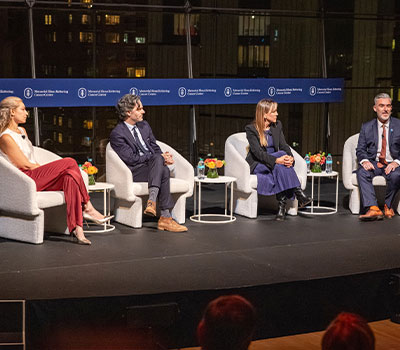
Perhaps no other breakthrough exemplifies the idea of “tomorrow’s treatments” better than immunotherapy, which harnesses the body’s own defenses to fight cancer. “It’s a revolution 100 years in the making,” says MSK cellular therapist and early drug development specialist Christopher Klebanoff, MD, one of four faculty members who shared their experiences and insights during the forum. The idea that the immune system could recognize and kill cancer cells was proposed by MSK surgeon William Coley in the 1890s, but it was only in the past 20 years that scientists — many of them at MSK — made immunotherapy a reality and forever changed what was possible in cancer treatment.
Gastrointestinal medical oncologist Andrea Cercek, MD, Section Head for Colorectal Cancer, Co-Director of the Center for Young Onset Colorectal and Gastrointestinal Cancer, and The Ford Family Chair, has a front-row seat to the remarkable power of immunotherapy drugs called checkpoint inhibitors, which remove the brakes that cancer cells use to stop the immune system from attacking them. When used to treat cancers that have many mutations — a trait that makes tumor cells look abnormal and easier for the immune system to find — checkpoint inhibitors can mobilize immune cells to completely eradicate cancer in some people.
Six years ago, Dr. Cercek launched what would become a landmark clinical trial for people with locally advanced rectal cancer, a disease that historically has been treated with chemotherapy and life-altering surgery. Every participant received immunotherapy as a first-line treatment and saw their disease disappear completely without surgery. This approach is now the standard of care for certain rectal cancers. “Our immune system is absolutely the most powerful cancer-fighting tool there is — as long as we know how to tap into it,” she says.
Dr. Klebanoff was drawn to immunotherapy because of its stark differences from traditional cancer therapies. “We’re empowering patients to treat themselves by modulating their immune systems — that idea has always captured my imagination,” he says. Dr. Klebanoff is leading research in a technique that uses immune cells themselves as treatment, but with a twist. “For about 80% of cancers, there are either not enough or no natural immune cells that can recognize cancer,” he explains. “But we can take immune cells out of the body, genetically reprogram them to spot cancer cells, and infuse them back into the patient.”
While Dr. Klebanoff acknowledges that the process sounds “very space-age,” cellular therapy has become a lifesaving strategy for people with blood cancers and several other types of the disease. MSK’s pioneering work in this area has vaulted it to the forefront of the field. Today, six of the nine FDA-approved cellular therapies for cancer — none of which existed just 10 years ago — have their roots at MSK.
When Perseverance Meets Generosity
Bringing a new treatment full circle, from an idea to an approved therapy for people with cancer, is not a task for the easily daunted. “It takes perseverance and resiliency, which are key attributes I see in my colleagues,” says Dr. Klebanoff. Dr. Cercek adds that having the ability to continually pursue better treatments is one of the unique things about working at MSK. “We have the patient volume, the translational capabilities, and the scientists who enable us to go from the clinic to the lab and right back again — where we can literally change patients’ lives,” she says.
The other force driving innovation at MSK is philanthropy. “Almost none of my work would be possible without it,” Dr. Cercek says, explaining that donor support is essential from the earliest stages of research to the clinical trials that show whether a new drug is safe and effective for patients. “If you don’t have the funding, you’re stuck — nothing happens,” she says.
Sarcoma oncologist Lauren Baker Banks, MD, PhD, who was a research fellow in Dr. Klebanoff’s lab before joining the MSK faculty, is creating cellular therapies for a rare and aggressive cancer that strikes teens and young adults. Like many scientists working on rare cancers, Dr. Banks had few options for funding this effort, despite its lifesaving potential. Philanthropy is pushing her project forward. “I don’t think I could do this work anywhere else,” she says. Oncologist Benoit Rousseau, MD, PhD, has found that private funders are willing to back “projects that nobody else would take a chance on.” He points to Dr. Cercek’s immunotherapy clinical trial for rectal cancer, which he helped lead during his research fellowship and continues to collaborate on today. That trial still boasts a 100% response rate and has changed care for patients around the world. “At MSK, you can dream big,” he says. “I was trained to share bad news with people, but here, we get to deliver good news.”
From Fear to Hope
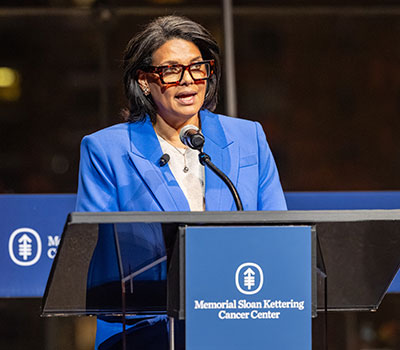
It was the fall of 2023 when Sara Sidner received her own life-changing news. The CNN anchor and Senior National Correspondent had just returned from a reporting trip abroad when she learned she had stage 3 breast cancer. She had recently relocated to New York City, and a colleague encouraged her to go to MSK. One year after that first appointment, a time when Sidner admits to feeling “terrified,” she was cancer free.
In the closing remarks of the Presidential Forum, Sidner shared what she called “a love letter” to the MSK nurses, doctors, scientists, office staff, therapists — even the maintenance staff — whose expertise, empathy, and kindness saw her through some of the darkest days of her life. “It was not just poking and prodding and trying to get this disease out of my system,” she recalls. “It was singularly about being human.”
Looking Ahead
All of us at MSK are united in our mission to end cancer for life. But like every quest, it’s one we can’t conquer alone. Throughout our history, the generosity of MSK’s donor community has helped us turn our most ambitious ideas into transformative treatments for people with cancer. Now, your continued support is helping us rewrite the future of cancer care, giving our doctors and scientists the resources they need to be truly unstoppable. We are so grateful for your partnership.


